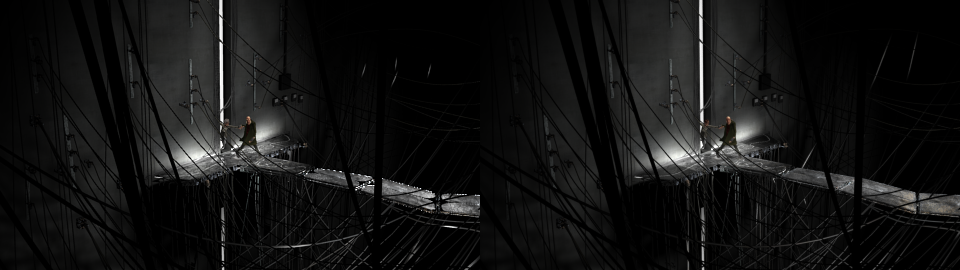
An open film can age too
Elephants Dream, the 2006 Orange project film, left something invaluable behind: production files. But having sources does not mean modern software can reproduce their behavior. In this case, the original shot uses a big-endian format that the target Blender 5.2.2 no longer opens. Legacy Blender Internal, materials, drivers and the compositor also have a different history from today's Cycles.
First, recover a reference
I began by preserving both DVD images, PAL and NTSC, and verifying their checksums. Their assets complement each other. Character and environment libraries, textures and shot files have to be found and connected before migration can begin. Originals stay outside the experiments, and work happens on copies.
Blender 2.42a ran headlessly in an emulated i386 environment. For shot 03_02 it rendered frame 88 at the original 1920×1080 resolution, including the compositor. That took almost 56 minutes. The result provides a measurable reference for checking the new version; supporting comparisons use a separate 480×270 profile.
Animation must stay live
The path to Blender 5.2.2 LTS on Apple Silicon prepares data in native 2.42a and reconstructs it in the new application. Accepted structural checkpoint v4 preserves 1,311 source objects, 35 source Actions, 49 image references and two linked libraries. Helper objects and an additional camera action are counted separately.
Small differences demand the most patience: scale application order, quaternion blending, B-Bone behavior, curve handles and subdivision. I reconstruct their rules while keeping the animation editable. Each repair has a defined scope and a comparison with the old Blender. Structural agreement still leaves image fidelity to resolve.
Materials remember the old renderer
Color, reflections, transparency and shadows come from the original engine's particular calculations. Experiment v11 reconstructs legacy materials, procedural textures, lights and part of the compositor. In frame-88 tests, pre-compositor RGB error fell from RMSE 0.132426 to 0.032902. That result belongs to a specific test profile; it does not establish fidelity for the entire film.
Differences remain in glass ray histories, texture filtering, hair and motion blur. More samples reduce noise but cannot repair incorrect semantics. That is why the accepted structural checkpoint and render experiments have separate statuses.
What v12 brought
The October 14 report describes an extended set of 60 shots. V11 produced 23 genuine source renders; v12 has 41. The remaining 19 are still blocked by issues including memory limits, swap growth and unsupported compositor elements. Only one shot in this extended set has confirmed visual and temporal qualification.
Progress comes from recovering original dependencies, fixing compositor-group import, handling legacy character data in the telephone library, and reconstructing Blur filters and image-channel conversions. A completed PNG starts the assessment: appearance, asset provenance and behavior across successive frames still need checking.
Where this port is heading
I want to preserve a project that can be opened, understood and studied further. The current state reproduces selected scenes and supports comparisons between versions, but the migration remains incomplete. The next step is to close dependency and rendering gaps, then assess full resolution and animation continuity. Twenty years later, the same dream still has something to teach us.
Based on local source-preservation, structural-migration and v12 visual-reconstruction reports dated October 14, 2026. Counts describe the extended 60-shot set, not the entire film.