It was a day when code refused to stay two-dimensional. First I fixed SIGNAL BREACH. Literal truncation markers in the source had broken the CSS and JavaScript. After restoring the missing sections, the game launched correctly again. Shortly afterwards it gained mobile controls: separate movement and firing joysticks and a panel that does not obscure the playfield.
NULL FRONTIER changes course
Next came NULL FRONTIER, initially an experiment in walking through revealed sectors. Its first physics model mixed world, camera and screen coordinates, so I rebuilt it as a clear vertical aircraft shooter in the spirit of retro arcades.
- 12 longer stages with their own bosses,
- enemy formations, gunfire and later bullet-hell sequences,
- upgrades between levels,
- keyboard and touch controls.
The biggest experiment: KITE LAB VR
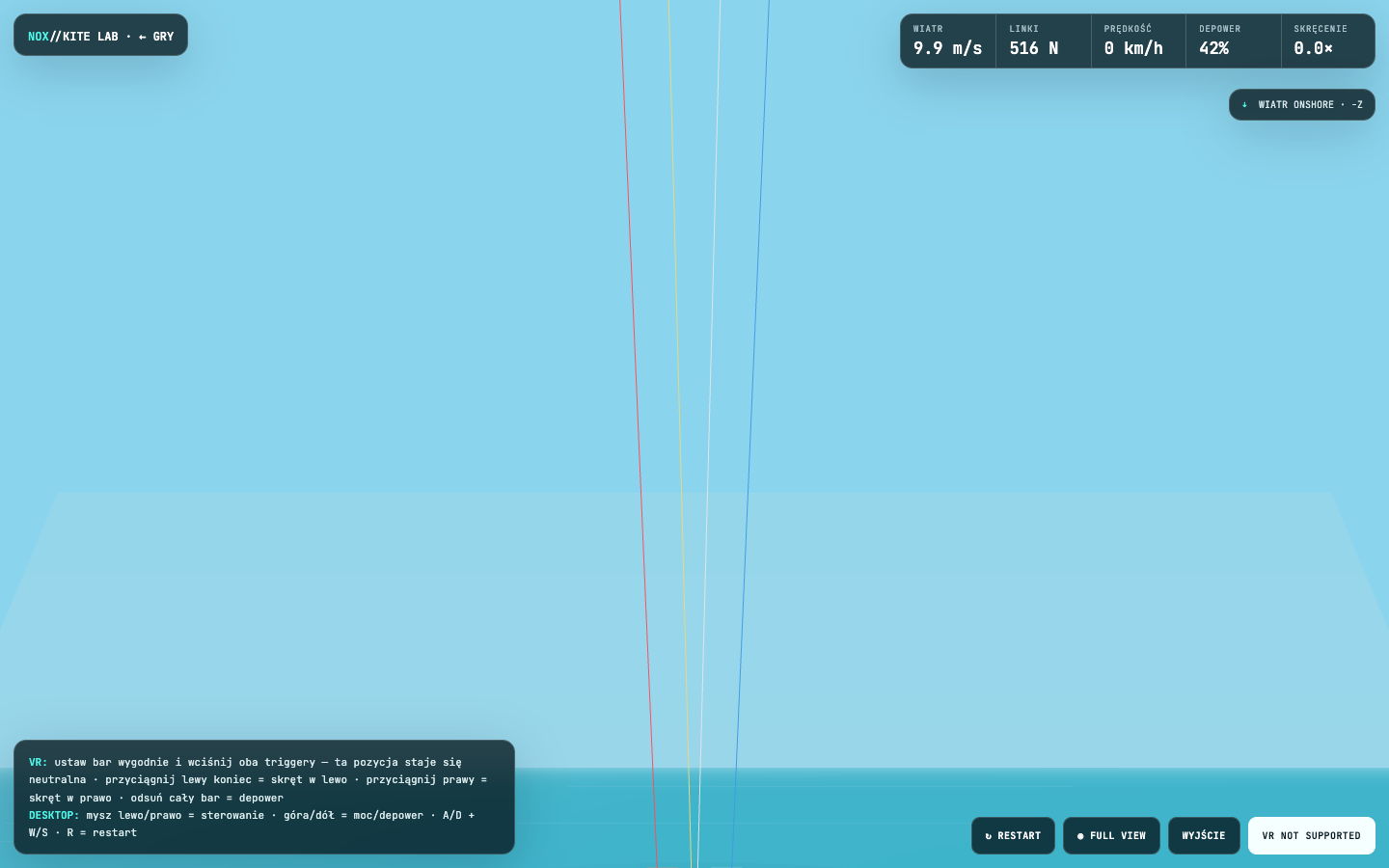
In the evening, work moved to WebXR. The goal was a kitesurfing kite simulator driven by actual interaction. Users grab the ends of the control bar with their controllers, and the difference in hand position turns the canopy. Pushing the bar away or pulling it closer changes depower.
The first model felt too artificial: it bounced off the wind-window boundaries and could break symmetry without a control input. I replaced it with a spherical-motion model based on kite aerodynamics, apparent wind and RK4 integration. I added four lines, tension in newtons, stalls, gusts and equivalent working mouse and keyboard controls.
One day did not close every issue. Bar feel, behavior at the wind-window edge and control sensitivity still needed testing on a real Quest. But the key part already worked: the kite had become a system that could be studied and calibrated.